News | company news | Jun 06,2025
What kind of sensors are needed for charging piles in Korea?
Development Status and Goals
Infrastructure scale
– As of May 2023, there are 241,000 public charging stations in South Korea, of which fast charging stations account for 10.6% (about 25,500), and slow charging stations account for the majority.
The city of Seoul plans to deploy 200,000 charging devices (including 5,000 fast-charging piles and 195,000 slow-charging piles) by 2025 to realize a “5-minute walking charging network” in the living circle, covering the needs of 500,000 electric vehicles.
– National target: The government plans to build 500,000 charging stations (including public and private ones) by 2025, covering cities, highways and residential areas.
Leading global coverage and efficiency
– South Korea has the highest density of charging stations in the world: each charging station serves 2 electric vehicles (the global average is 11), and the average charging power per vehicle is 7kW (the global average is 2.4kW).
– Fast charging stations will be installed every 50 kilometers on highways, and all major urban business districts and residential areas will be fully covered.
User needs and challenges
Charging anxiety is alleviated: 60% of consumers hesitated to buy a car due to “few charging piles + slow charging”. The government responded by increasing density and fast charging technology.
Adaptation to multiple scenarios: Slow charging is mainly used in residential areas, supercharging piles are installed in business districts/highways, and sharing modes (such as opening of community charging piles) improve utilization rate.
Future Trends (After 2025)
Commercial use of solid-state batteries: fully applied in 2030, battery life increased by 40% and charging time halved.
What products does HEYI Electric have that are suitable for charging pile construction in South Korea?
HYCA-10 series, this is our company’s representative product exported to South Korea
The HYCA-10 from Wenzhou HEYI Electrical Co., Ltd. is a precision residual current detection module designed for safety-critical applications. This compact PCB-mounted solution offers comprehensive AC/DC leakage current monitoring with advanced self-test capabilities, making it particularly suitable for electric vehicle charging infrastructure and industrial power systems.
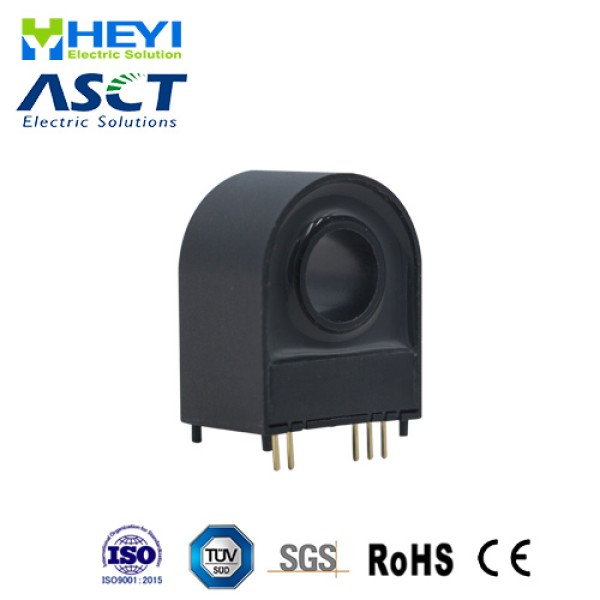
Dual Output Indication: Features both X6-OUT (DC trip) and X30-OUT (AC trip) for comprehensive fault detection
Precision PWM Output: Provides 8kHz PWM signal with 3.33%/mADC resolution (0-30mADC range)
Advanced Self-Test: Integrated calibration and verification system with simulated 6.53mADC test current
Hysteresis Protection: Intelligent flip thresholds (100% trip/55% recovery) prevent signal oscillation
Compact Integration: PCB-mounted design optimizes space utilizatio
HYCA-10 Recommended For:
Ground fault detection in industrial equipment
Leakage current monitoring in power converters
Compact EV charging stations (motorcycles, bicycles)
Systems requiring precise DC residual current measurement
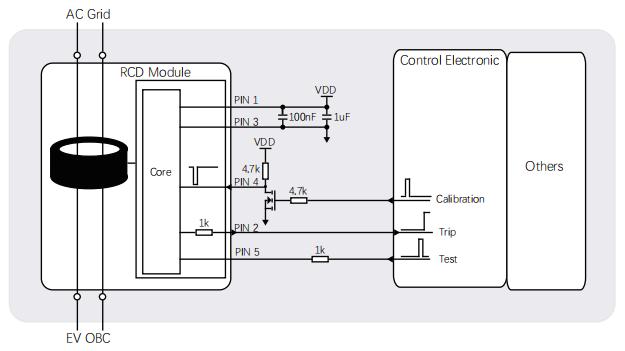
Typical Application Schematic:
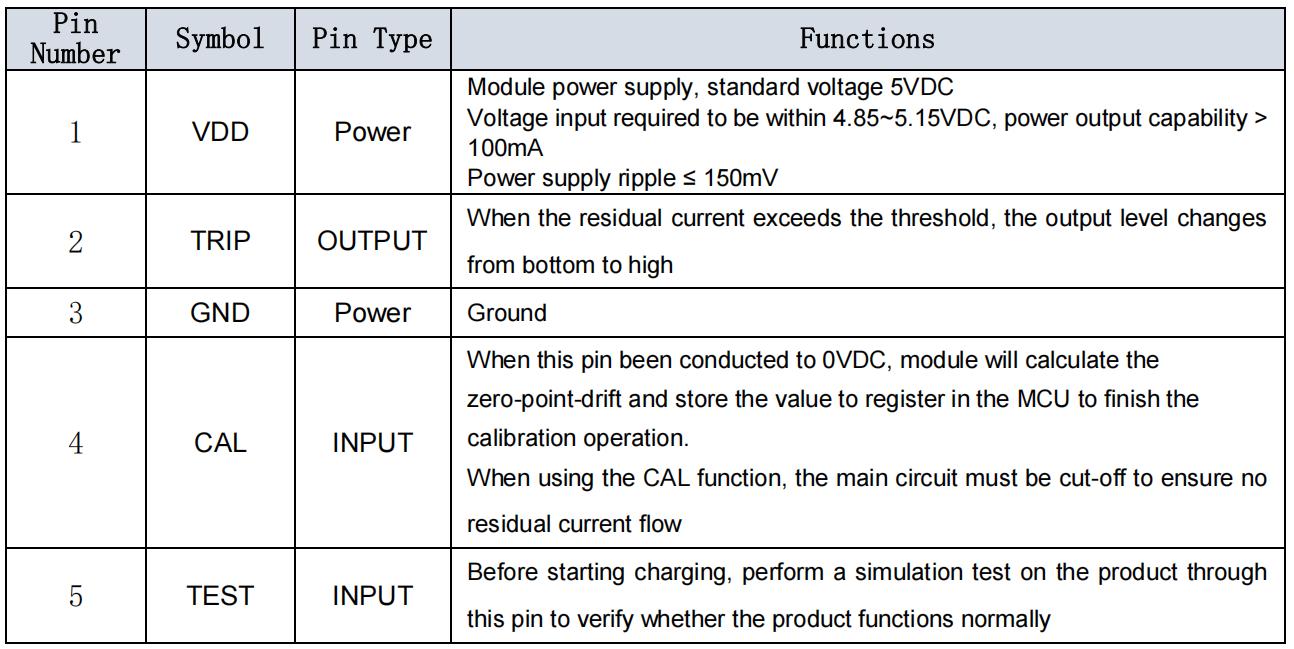
Pin Definition:
HYCA-10 Recommended For:
Ground fault detection in industrial equipment
Leakage current monitoring in power converters
Compact EV charging stations (motorcycles, bicycles)
Systems requiring precise DC residual current measurement
Features
Applications
Standard
Overview
An important safety function of these devices is monitor of the leakage current of the entire system
from Power modules against earth. A defective system can become dangerous for people or
cause fires. Before it comes so far, Power modules must be disconnect from the grid. The leakage
current contains DC and AC components. Therefore an AC/DC-sensitive monitoring unit is
necessary.
--- END ---

COPYRIGHT © HEYI ELECTRICS SOLUTION


