


Introduce
Summation current transformer are suitable for the summation of several synchronous alternating currents with similar phase position.but with different loaded phase shifts. lt is also possible to have the summation ofcurents with varied nominal voltages ofsimilar phase positionsThese measurements are not suitable for tariffapplications, since the existing voltage differences are recorded as errors.SUM 125 curent transformer can be either fastened with four M6 screws or mounted on 35mm DIN-rails (Note: To avoid overloading, currenttransformers must be mounted horizontally,) SUM 155 must be fastened with four M6 screws.


SUM125 Summation Current Transformer
Summation current transformers (SUM series) combine multiple synchronous AC currents with similar phase positions but different load phase shifts or nominal voltages. They are not suitable for tariff measurements due to voltage differences.
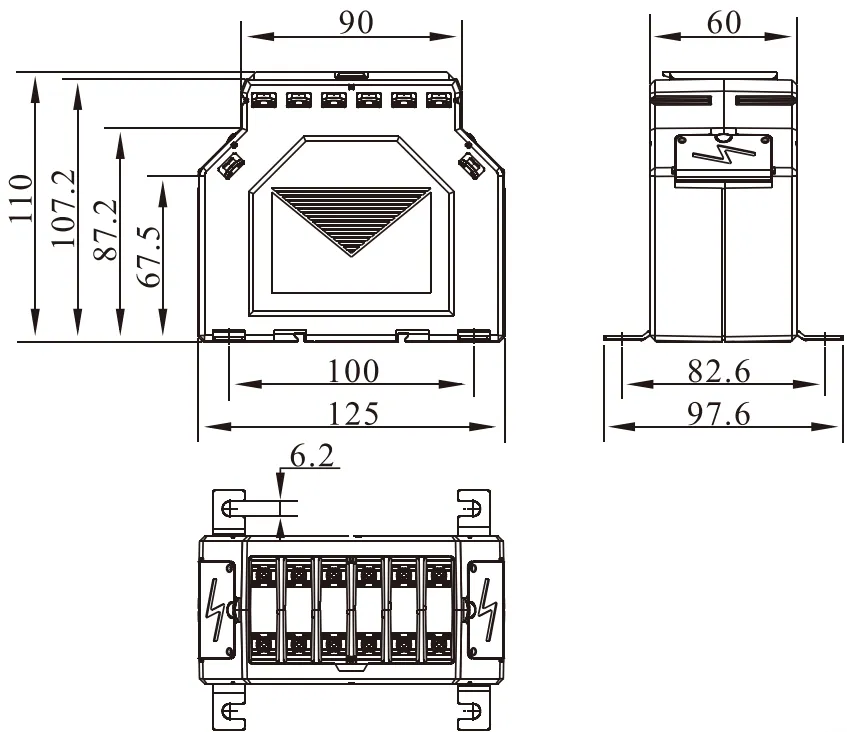
SUM125 can be mounted horizontally using four M6 screws or on a 35 mm DIN rail; SUM155 requires four M6 screws.


Applications
- Summary of Current Signals in Power Systems
- Multi channel current monitoring in industrial automation
- In situations where multiple current signals need to be merged into one signal
- Power system protection and control devices
Sdandard
The application of SUM125 Summation Current Transformer in the power system must meet the following standard requirements:
1. Power system protection standards: such as IEEE C57.12.90-2021 testing requirements for power transformers.
2. EMC standards: including electromagnetic compatibility requirements such as EN 55022 (conducted interference) and EN 55015 (space radiation).
3. Safety standards: requirements for enhanced insulation, such as IEC 61558-1 and UL 62368-1.
Technical Parameter

Dimensions
FAQ
1. How many CT secondary currents can the SUM125 combine?
The SUM125 is designed to combine multiple AC current signals into one output for monitoring or control. The supported number of inputs depends on the selected configuration. Please send us the number of CTs and their secondary ratings so we can recommend a suitable model.
2. Can the SUM125 combine CTs with different ratios?
The input CT ratios must be reviewed together to obtain the intended summed output. Please provide each CT ratio, secondary current and the output required by your meter or relay. Our engineers can then check whether a standard SUM125 configuration is suitable.
3. How do I choose the rated burden (VA) for a SUM125 summation current transformer?
The connected burden depends on the meter or relay input, secondary cable resistance and any other devices in the circuit. For selection, please provide the cable length and cross-sectional area, the connected equipment burden, and the required output current. We will check the total burden against the proposed SUM125 rating.
4. Can the SUM125 be used for revenue metering?
The product page states that summing currents from circuits with different nominal voltages is not suitable for tariff metering, because voltage differences can introduce measurement errors. Please share the circuit arrangement and metering purpose before selecting the SUM125 for a billing application. www.heyiele.com
5. How should the SUM125 be installed?
The SUM125 can be fixed horizontally with four M6 screws or mounted on a 35 mm DIN rail. When wiring the input CTs, follow the terminal markings and maintain consistent polarity so the currents sum as intended. Please request the wiring diagram for your selected input configuration before installation.
