Introduce
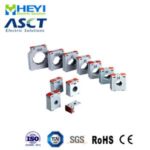
CP range of current transformers are compact-smaller than other models with the current ratio of the transformer is small Clamshell-style terminal cover is well protected by the second terminal.With related accessories you can use Din rail mounting a current from 5A to 3000A.
Applications
Current measurement, monitoring and piotection for electrical wiring and equipment.
Current and power measurement for electric motors, lighting,air compressor, heating and ventilation system.
Air-condition equipment and Current, power and energy monitoring device.
Relay protection device.
Features
Three built in fixing methods: Panel/Din Rail/Busbar.
Built in hinged terminal cover.
Compact design.
Primary current from 5A to 3000A.
Technical Parameter
| Electrical Parameter | Mechanical Parameter | ||
| Frequency | 50/60Hz | Case | PC/UL94-V0 |
| Rated Input | 5A-3000A | Bobbin | PBT |
| Measuring range | 5%In-120%In | Core | Silicon steel |
| Rated Output | 1A,5A | Construction | Screw |
| Ratio Voltage | 0.72KV (AC) | Operating Temp | -25℃~+75℃ |
| Dielectric strength | 3.0KV/1mA/1min | Operating Humidity | ≤85% |
| Insulation Resistance | DC500V/100MΩ min | Output Connection | Terminal |
Specification
| Type | Ratio(A) | Burden(VA) | Frequency(Hz) | ||
| class:0.5s | class:0.5 | class:1.0 | |||
| CP-62/B | 5/5A | 2.5 | 2.5 | 2.5 | 50/60 |
| 10/5A | 2.5 | 2.5 | 2.5 | 50/60 | |
| 15/5A | 2.5 | 2.5 | 2.5 | 50/60 | |
| 20/5A | 2.5 | 2.5 | 2.5 | 50/60 | |
| 25/5A | 2.5 | 2.5 | 2.5 | 50/60 | |
| 30/5A | 2.5 | 2.5 | 2.5 | 50/60 | |
| 40/5A | 2.5 | 2.5 | 2.5 | 50/60 | |
| 50/5A | 2.5 | 2.5 | 2.5 | 50/60 | |
| 60/5A | 2.5 | 2.5 | 2.5 | 50/60 | |
| 75/5A | 2.5 | 2.5 | 2.5 | 50/60 | |
| 100/5A | 2.5 | 2.5 | 2.5 | 50/60 | |
| 150/5A | 2.5 | 2.5 | 2.5 | 50/60 | |
| Type | Ratio(A) | Burden(VA) | Frequency(Hz) | ||
| class:0.5s | class:0.5 | class:1.0 | |||
| CP-62/20 | 30/5A | – | – | 2.5(4T) | 50/60 |
| 40/5A | – | – | 2.5(3T) | 50/60 | |
| 50/5A | – | – | 2.5(3T) | 50/60 | |
| 60/5A | – | – | 2.5(2T) | 50/60 | |
| 75/5A | – | – | 1.5 | 50/60 | |
| 80/5A | – | – | 2.5 | 50/60 | |
| 100/5A | 2.5 | 2.5 | 2.5 | 50/60 | |
| 150/5A | 2.5 | 2.5 | 3.75 | 50/60 | |
| 200/5A | 2.5 | 3.75 | 5 | 50/60 | |
| Type | Ratio(A) | Burden(VA) | Frequency(Hz) | ||
| class:0.5s | class:0.5 | class:1.0 | |||
| CP-62/30 | 50/5A | – | – | 2.5(2T) | 50/60 |
| 60/5A | – | – | 2.5(2T) | 50/60 | |
| 75/5A | – | – | 1.5 | 50/60 | |
| 100/5A | 2.5 | 2.5 | 2.5 | 50/60 | |
| 150/5A | 2.5 | 2.5 | 3.5 | 50/60 | |
| 200/5A | 2.5 | 3.5 | 5 | 50/60 | |
| 250/5A | 2.5 | 5 | 5 | 50/60 | |
| 300/5A | 2.5 | 5 | 5 | 50/60 | |
| 400/5A | 3.75 | 5 | 5 | 50/60 | |
| Type | Ratio(A) | Burden(VA) | Frequency(Hz) | ||
| class:0.5s | class:0.5 | class:1.0 | |||
| CP-62/40 | 60/5A | – | – | 2.5(2T) | 50/60 |
| 75/5A | – | – | 2.5(2T) | 50/60 | |
| 100/5A | – | – | 1 | 50/60 | |
| 150/5A | – | – | 2.5 | 50/60 | |
| 200/5A | 2.5 | 2.5 | 3.75 | 50/60 | |
| 250/5A | 2.5 | 2.5 | 5 | 50/60 | |
| 300/5A | 2.5 | 5 | 6 | 50/60 | |
| 400/5A | 2.5 | 5 | 6 | 50/60 | |
| Type | Ratio(A) | Burden(VA) | Frequency(Hz) | ||
| class:0.5s | class:0.5 | class:1.0 | |||
| CP-80/30 | 30/5A | – | – | 2.5(4T) | 50/60 |
| 50/5A | – | – | 2.5(2T) | 50/60 | |
| 60/5A | – | – | 2.5(2T) | 50/60 | |
| 75/5A | – | – | 1.5 | 50/60 | |
| 100/5A | 2.5 | 2.5 | 2.5 | 50/60 | |
| 150/5A | 2.5 | 2.5 | 3.75 | 50/60 | |
| 200/5A | 3.75 | 3.75 | 5 | 50/60 | |
| 250/5A | 5 | 5 | 7.5 | 50/60 | |
| 300/5A | 5 | 5 | 7.5 | 50/60 | |
| Type | Ratio(A) | Burden(VA) | Frequency(Hz) | ||
| class:0.5s | class:0.5 | class:1.0 | |||
| CP-80/40 | 100/5A | – | – | 2.5 | 50/60 |
| 150/5A | 2.5 | 2.5 | 3.75 | 50/60 | |
| 200/5A | 2.5 | 3.75 | 5 | 50/60 | |
| 200/5A | 2.5 | 3.75 | 5 | 50/60 | |
| 300/5A | 5 | 5 | 5 | 50/60 | |
| 400/5A | 5 | 5 | 10 | 50/60 | |
| 500/5A | 5 | 5 | 10 | 50/60 | |
| Type | Ratio(A) | Burden(VA) | Frequency(Hz) | ||
| class:0.5s | class:0.5 | class:1.0 | |||
| CP-86/60 | 250/5A | 2.5 | 2.5 | 5 | 50/60 |
| 300/5A | 2.5 | 5 | 5 | 50/60 | |
| 400/5A | 2.5 | 5 | 7.5 | 50/60 | |
| 500/5A | 2.5 | 5 | 7.5 | 50/60 | |
| 600/5A | 5 | 7.5 | 10 | 50/60 | |
| 750/5A | 5 | 10 | 15 | 50/60 | |
| 800/5A | 5 | 10 | 15 | 50/60 | |
| 1000/5A | 7.5 | 10 | 15 | 50/60 | |
| Type | Ratio(A) | Burden(VA) | Frequency(Hz) | ||
| class:0.5s | class:0.5 | class:1.0 | |||
| CP-100/60 | 400/5A | 2.5 | 5 | 7.5 | 50/60 |
| 500/5A | 2.5 | 5 | 7.5 | 50/60 | |
| 600/5A | 5 | 7.5 | 10 | 50/60 | |
| 750/5A | 5 | 10 | 15 | 50/60 | |
| 800/5A | 5 | 10 | 15 | 50/60 | |
| 1000/5A | 7.5 | 10 | 15 | 50/60 | |
| 1200/5A | 15 | 15 | 15 | 50/60 | |
| 1500/5A | 15 | 15 | 15 | 50/60 | |
| 1600/5A | 15 | 15 | 15 | 50/60 | |
| Type | Ratio(A) | Burden(VA) | Frequency(Hz) | ||
| class:0.5s | class:0.5 | class:1.0 | |||
| CP-104/80 | 600/5A | 2.5 | 7.5 | 10 | 50/60 |
| 750/5A | 2.5 | 7.5 | 10 | 50/60 | |
| 800/5A | 5 | 10 | 10 | 50/60 | |
| 1000/5A | 7.5 | 10 | 15 | 50/60 | |
| 1200/5A | 10 | 10 | 15 | 50/60 | |
| 1250/5A | 10 | 10 | 15 | 50/60 | |
| 1500/5A | 10 | 15 | 15 | 50/60 | |
| 1600/5A | 10 | 15 | 15 | 50/60 | |
| 2000/5A | 10 | 15 | 15 | 50/60 | |
| Type | Ratio(A) | Burden(VA) | Frequency(Hz) | ||
| class:0.5s | class:0.5 | class:1.0 | |||
| CO-140/100 | 800/5A | 5 | 10 | 10 | 50/60 |
| 1000/5A | 5 | 10 | 15 | 50/60 | |
| 1200/5A | 10 | 15 | 15 | 50/60 | |
| 1250/5A | 10 | 15 | 15 | 50/60 | |
| 1500/5A | 15 | 15 | 15 | 50/60 | |
| 1600/5A | 15 | 15 | 15 | 50/60 | |
| 2000/5A | 15 | 15 | 15 | 50/60 | |
| 2500/5A | 15 | 15 | 15 | 50/60 | |
| 3000/5A | 15 | 15 | 15 | 50/60 | |