News | company news | Mar 30,2026
From smart factories in Vietnam to charging infrastructure networks for electric vehicles in Thailand and data centers in Singapore – Southeast Asia is rapidly developing into a hub for AI-powered infrastructure development.
Behind every “intelligent system”, however, lies the solution to a central problem by the engineers:
How can we accurately measure and transmit electricity data in real time?
Lack of reliable and up-to-date data:
When engineers search for information, they are looking for far more than just a product.
They asked the following questions:
Short:
You need an AI-compatible current sensor.
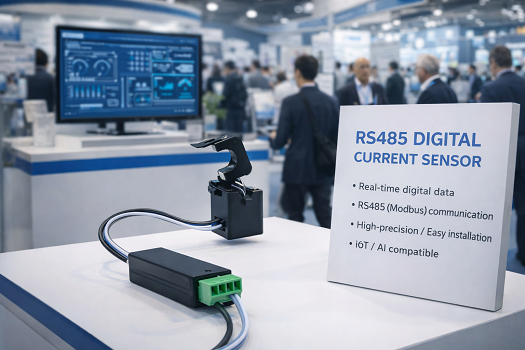
For modern artificial intelligence and Internet of Things systems, current sensors must meet four key requirements:
1.Digital communication (not limited to analog signals)
Conventional signals (such as 4-20 mA) have their limitations.
The following is required for artificial intelligence systems to function:
Real-time data
Telecommunication
Network with multiple devices
Solution: RS485 + Modbus
2.Ensuring the reliability of high-precision data
Data quality is of utmost importance in artificial intelligence systems.
We recommend the following:
Accuracy ≤ 1%
Stable output power even with temperature fluctuations.

3.Easy installation (especially suitable for renovation work)
Factories in Southeast Asia tend to modernize their existing systems.
Engineers typically proceed as follows:
Separate core design (without automatic shutdown function)
Quick installation
4- Multi-criteria monitoring (not limited to the current level)
Artificial intelligence systems require a higher performance level than current ones:
Voltage
that power
energy
Performance factor
More data → Better decisions with the help of artificial intelligence
Recommended solution: Digital power converters for artificial intelligence systems.
Due to these requirements, digital current sensors with data transmission capability have established themselves as the preferred solution.
Example: HYKCD-16 digital power supply
This solution was specifically designed for the integration of intelligent monitoring and artificial intelligence:
Key features:
RS485 (Modbus) connection → enables the integration of PLCs and IoT.
High accuracy (level 1.0) ← Delivers reliable data for AI analysis.
Separate core design ← No need to separate chain links
Low power consumption ≤ 110 mW → Ideal for IoT systems
Wide range power supply (10-14V DC)
Real-time data output (which is crucial for artificial intelligence)
Unlike conventional computed tomography (CT) scanners, this device delivers results directly:
All Modbus data sets (supports integration with cloud services/SCADA).
Practical application in Southeast Asia
1.Smart Factory (Vietnam/Indonesia)
Monitoring of engine activity
Predictive maintenance
Improvement of energy consumption
Artificial intelligence detects anomalies based on current patterns.
2.Charging system for electric vehicles (Thailand/Malaysia)
Leak detection
Load distribution
Security monitoring
Up-to-date real-time data is essential for compliance with legal regulations.
3.Data Center (Singapore)
Energy Efficiency (PUE)
Server load monitoring
High accuracy = higher energy efficiency
4.Solar panels and energy storage systems
Inverter monitoring
Network stability analysis

According to a trend analysis on search engine optimization , the search queries of engineers show the following trends:
The programmable logic controller (PLC) uses an RS485 digital current sensor.
Modbus current sensor for IoT
Comparison between digital and analog current transformers
Because
| Conventional sensors | RS485 digital sensor |
| only 4-20 mA | Direct data transfer |
| Limited data | Multi-parameter output |
| Its size is difficult to determine. | Simple network connection |
| Artificial intelligence is not supported. | The AI is ready |
Typically, engineers must check the following before purchasing:
Communication protocol (RS485/Modbus?)
Accuracy (≤1%?)
Structure type (divided heart?)
Output parameters (power/energy?)
Compatibility (PLC/SCADA/IoT?)
In short: Engineers don’t buy sensors, they buy data.
In the rapidly developing field of artificial intelligence in Southeast Asia:
The role of modern sensors is changing.
out of
Current measurement
To
Providing reliable data for informed decisions.
Call to work
When you perform the treatment:
Modernization of smart factories
Charging system for electric vehicles
Energy monitoring platform
IoT-based energy systems
Choosing a current sensor with digital connectivity is now a necessity and no longer just an additional feature.
Compay:HEYI Electrical Co., Ltd.
Brand: HEYI/ASCT
Contact: Bethy
E-mail: heyi@heyiele.com
Tel: 86-13968747975
--- END ---
Prev: Are Split Core CTs Accurate Enough for Energy Metering?
Already the latest article

COPYRIGHT © HEYI ELECTRICS SOLUTION


