News | | Feb 25,2026
—In-depth analysis current transmitter of Korean IoT energy monitoring and smart power distribution market
In Korea’s industrial and building energy management systems, current monitoring devices are rapidly upgrading from traditional meters to real-time data nodes that can be connected to IoT gateways.
Especially in BEMS, FEMS, smart factories, and photovoltaic systems, two-wire 4-20mA current transmitter have become the most stable, standard, and PLC/gateway compatible sensing layer devices.
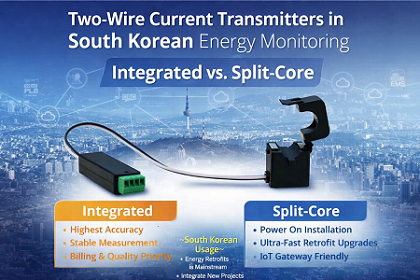
There are two main ways that technology is being used right now.
Integrated current transmitter (Integral / Solid-core transmitter)
Split-core/Dismountable transmitter
The two exhibit significantly different application ecosystems in Korean market.
South Korea isn’t just a place where things are cheap, it’s a market that has really high standards and a huge need for change, plus a lot of people are using the internet to connect all sorts of devices.
Typical characteristics:
Many industrial buildings in Korea were constructed between 1990 and 2010.
Therefore, prolonged power outages are not permitted, busbar removal is not allowed, and production disruptions are not permitted.
This directly led to:
In some parts of the world, people really like split-type products, way more than in Europe or the US.
In Korea, the usual setup for smart power monitoring is like this:
Sensor → 4-20mA → PLC / DAQ → RS485 → IoT Gateway → Cloud EMS
reason:
EMC stable
Long-distance anti-interference
Easy to pass KC certification
Compatible with older systems
Therefore, two-wire transmitters are more readily adopted than RS485 sensors.
Korea’s K-RE100 energy standard and energy-efficient building regulations require:
Sub-circuit metering
Equipment-level energy consumption
Real-time monitoring
This means:
There may be 20 to 80 current measuring points in the same distribution cabinet.
Therefore, installation cost becomes a key decision-making factor.
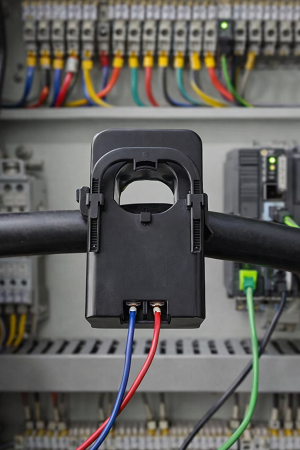
Working structure
The wire must pass through a closed iron
At its core, this means a really stable setup and the best possible magnetic connection.
Advantage
Magnetic circuit closed → Minimal leakage flux,
lowest temperature
drift, and small long-term drift
Suitable:
Korean-made inverters feature high density and integration, resulting in greater stability against high-frequency harmonics.
The structure is robust
and unaffected by vibration.
shortcoming
In Korea, it’s common for factories to say no when it comes to taking out stitches.
This is the biggest business obstacle.
Wages in Korea are a lot higher compared to many countries in Southeast Asia.
installation time > equipment costs.
Typical applications in South Korea
Scene Reasons for adoption
New semiconductor factory Precision priority
Electricity company metering Extremely high stability requirements
UPS / Data Center Backbone Long-term reliability
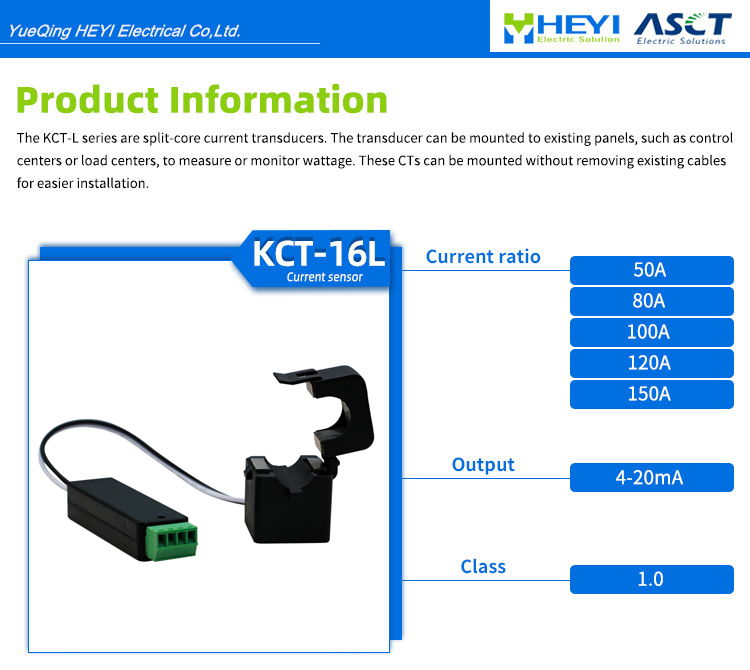
(Open-end Hall effect sensor/open-end CT + two-wire transmitter module)
Working structure
The iron core can be opened to clamp the cable
without disconnecting the power.
Advantage
That’s a huge advantage, especially in a country like Korea where having uninterrupted power supply is crucial. Not having to shut off the power to install it is a major benefit, making the whole process much more convenient and efficient.
In Korea, it’s seen as really important, something they can’t do without.
Downtime costs >> Sensor costs
especially:
Two, the installation process is really quick, it’s more than ten times faster than what you’d normally expect.
Installation completed in 1 minute,
suitable for batch renovation projects
Korean energy monitoring systems are often retrofitted.
Project features:
Split-type designs have almost become the default solution.
It can work with loads that use direct current, or ones that need a device to change the frequency, like those that have sensors called Hall effect sensors.
High proportion of new energy sources (photovoltaics, energy storage, EV charging)
make it impossible for traditional CT scanners to measure DC current.
shortcoming
The accuracy is slightly lower compared to the closed-type.
Air gaps cause incomplete magnetic circuit closure, making
temperature drift more sensitive.
project Integrated split type
Retrofit Modification ❌Difficulty ✅Best
Large-scale measurement points ❌High cost ✅Ideal
Accuracy billing ✅Best ⚠Medium
New energy DC ❌Regular CT scans are not sufficient. ✅ Hall effect support
Installation time slow Extremely fast
Korean market acceptance middle Very high
In Korea:
New projects tend to be integrated, while renovation projects almost always opt for modular designs.
South Korea’s core growth in energy digitalization comes from:
energy-saving retrofitting of old buildings + IoT EMS deployment.
Therefore, the market structure is:
Split type ≈ Mainstream
integrated type ≈ Special scenarios
Compay:HEYI Electrical Co., Ltd.
Brand: HEYI/ASCT
Contact: Bethy
E-mail: heyi@heyiele.com
Tel: 86-13968747975
--- END ---
Prev: Why split type current transformers Work with RCDs
Already the latest article

Feb 25, 2026
Two-wire current transmitter: Integrated vs. Split type —In-depth analysis current transmitter of Korean IoT energy monitoring and smart power distribution market In Korea’s industrial and building energy management systems, current monitoring devices are rapidly upgrading from traditional meters to real-time data nodes that can be connected to IoT gateways. Especially in BEMS, FEMS, smart factories,… Continue reading Split-Core vs Integrated 4-20mA Current Transmitter in Korea IoT Gateway

Feb 12, 2026
I am looking for a way to match type transformers with residual current circuit breakers. I want split type current transformers to match circuit breakers perfectly. The KCT series provides the basis, for this analysis and the application scenarios. In my work, with power distribution systems I see that residual current circuit breakers, also called… Continue reading Why split type current transformers Work with RCDs

Feb 04, 2026
Why is single‑phase window type current transformer so popular in the South American electricity market? —Technical Analysis Based on the South American Power Bureau’s Bidding and Outdoor Environment In countries, like Brazil, Chile, Peru and Colombia the power infrastructure construction has kept growing in recent years. The distribution network upgrades, the energy grid integration and the… Continue reading Why single‑phase window type current transformer Dominate South America’s Power Grid

COPYRIGHT © HEYI ELECTRICS SOLUTION

