News | | Jan 22,2026
In systems I see chillers, in commercial buildings air compressors in factories and generators, in data centers. The chillers, the air compressors and the generators all have one thing in common.
In short devices run by motors show their operating status in the current. The current tells the operating status of the device. I use the current as the sign of the operating status of a device.
I see that current transmitter are used a lot in the industries. Current transmitter matter. I see the KCT‑L series Hall effect transmitters, as an example of current transmitter. I notice that current transmitter now have a part, in the IOT. I notice that current transmitters also support the energy systems.
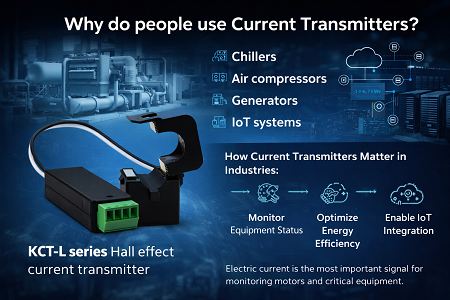
In settings the industrial settings can measure parameters:
However, for equipment with motors at its core, current is the most real and direct operating indicator.
We can quickly determine the result. Watch the current:
I am checking if the equipment is running.
Is there an overload?
Is it under light load or no load?
Can you tell me if equipment efficiency is going down?
I think current transmitters are sensors, in the industrial monitoring systems. Current transmitters are part of the industrial monitoring systems.
The main loads of the chiller include these items:
👉 All of them are typical motor loads.
Excessive starting means there is a problem. Excessive starting current can be a sign of a jam or an electrical fault.
I notice the operating current is rising slowly. The condenser becomes clogged. The heat exchange efficiency drops.
Abnormally low current: Insufficient refrigerant or compressor running under no-load.
I see that the long term trend shows equipment energy efficiency is declining. Equipment energy efficiency is not becoming more efficient, over time.
I am curious, about the KCT-L series. Why does the KCT-L series work well for chiller applications?
Suitable for 50/60 Hz AC current measurement
The 4–20 mA output can be directly connected to the BMS.
The 4–20 mA output can be directly connected to the PLC.
The 4–20 mA output can be directly connected to the energy management system.
Primary and secondary electrical isolation (up to 5 kV), suitable for installation inside distribution cabinets.
The sensor has a fast response time. I can see the sensor capture the compressor start‑up transient.
I have noticed that the current transmitters are equipment, in building automation systems. I have also noticed that the current transmitters are used in central air conditioning energy-saving renovation projects.
Air compressors consume a lot of power. Air compressors are one of the power users, in the setting.
Here are common air compressor problems:
Operating under no-load conditions but with persistently high energy consumption
I notice that mechanical wear makes the resistance increase. I see mechanical wear raising the resistance.
Frequent loading/unloading
The inefficient operation hides. I have seen the inefficient operation hide from view. The inefficient operation does not show up easily.
I can find these problems fast with the current:
High no-load current: abnormal mechanical resistance or internal wear
Large fluctuations in operating current: Instability in the control system or leakage in the pipeline network.
I notice that when the current rises slowly under the operating conditions the efficiency drops. I see the system trigger the maintenance warning signal.
Frequent starting current surges indicate a problem with the frequency converter or control logic.
Advantages of the KCT-L series in air compressors:
Wide bandwidth, suitable for variable frequency drive air compressors
I have tested the device. The device has -interference capabilities. I have used the device in electromagnetic environments. The device is suitable, for those environments.
Open-loop Hall structure, no risk of secondary open circuit.
I have installed the system. Found the installation flexible. I have performed maintenance. Did not have to disconnect the busbar.
I see many air compressor station energy saving management systems need data. Current data is the input signal. The system depends on data.
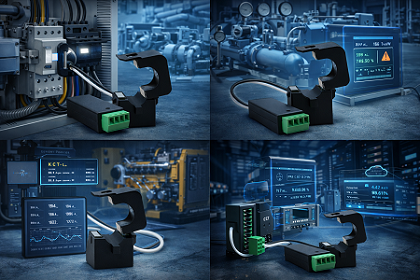
In generator systems, especially:
The role of current monitoring in generators:
I need to check if the three‑phase load’s balanced.
The trigger overload protection stops overloads. The trigger overload protection keeps the system safe. I trust the trigger overload protection to protect the machine.
Calculate the output power (P = U × I)
Conduct long-term operational status and trend analysis
I am curious why people prefer the Hall effect transmitters. I want to know what makes the Hall effect transmitters a choice.
The device can measure AC. The device can also measure DC and pulse current.
Maintains good linearity even at low currents
In my experience the electrical isolation makes the system security better. I have seen isolation work, in projects. I have also seen system security improve when electrical isolation is used.
4–20 mA signal, convenient for connection to monitoring systems
Therefore, current transmitters are an indispensable core component in generator control cabinets, remote monitoring, and unattended power stations.
I think about the IoT systems. The sensor signal should have these characteristics:
standardization
Strong anti-interference ability
Suitable for long-distance transmission
Easy to digitize
The 4–20 mA current signal is the “universal language” of the Industrial Internet of Things.
A typical IoT architecture looks like this:
Electric motor / Compressor / Generator
↓
KCT-L Current Transmitter
↓ (4–20 mA)
PLC / Data Acquisition Module
↓
IoT Gateway (Ethernet/4G)
↓
Cloud platform/Energy management system
I want to know. What can an IoT system get from the data?
Equipment running/shutdown status
Real-time and historical energy consumption data
Idle and Waste Identification
Predictive maintenance basis
Energy consumption cost analysis of a single unit
The value, in the digitalization of equipment comes from the current transmitter. In my view the single current transmitter captures the value in the digitalization of equipment. The single current transmitter does the work.
I looked at the KCT-L series. I see the core features of the KCT-L series include:
Open-loop Hall effect measurement principle
Supports AC/DC/pulse current
DC 4–20 mA Industry Standard Output
High precision, good linearity
Wide operating temperature range
Strong anti-interference and overload capabilities
Therefore, this product series is very suitable for applications such as:
Chillers and HVAC systems
air compressor
Generators and power equipment
Industrial IOT and Energy Consumption Monitoring Platform
I notice that the chillers, the air compressors and the generators have uses. I also notice that the chillers, the air compressors and the generators share a core.
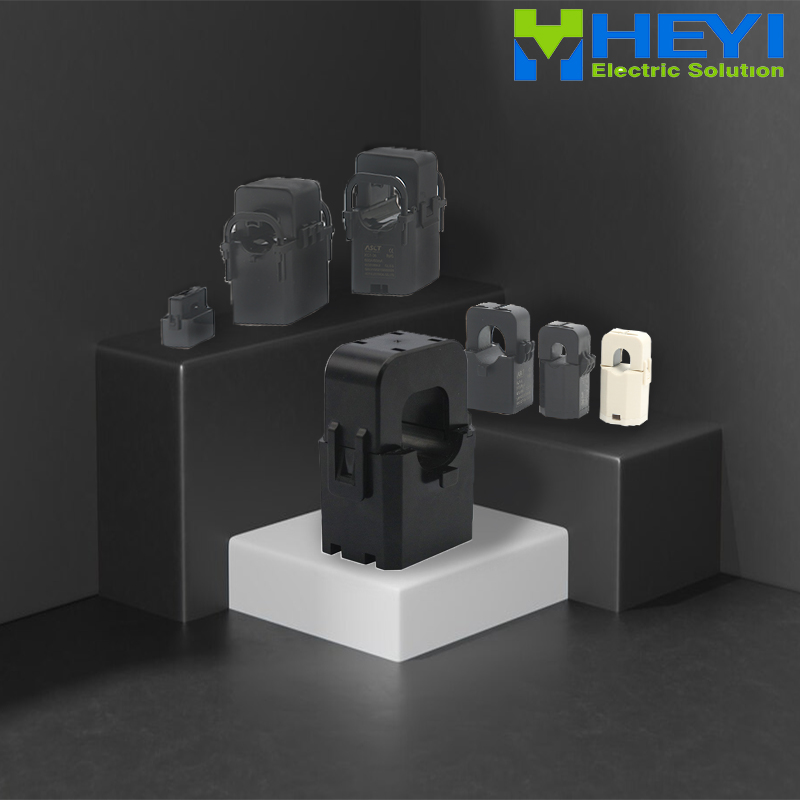
I see that the devices convert energy into energy.
Electric current is the most direct and real manifestation of this transformation process.
By converting current into a safe, isolated 4–20 mA signal suitable for IoT systems,
Products such, as the KCT-L series transmitters are now parts, in the modern industrial automation. The KCT-L series current transmitters also work in the monitoring systems. The KCT-L series current transmitters help keep the process running.
In short:
To truly understand the operating status of equipment, start by measuring the current.
Compay:HEYI Electrical Co., Ltd.
Brand: HEYI/ASCT
Contact: Bethy
E-mail: heyi@heyiele.com
Tel: 86-13968747975
--- END ---
Prev: Why HYLMZW4 current transformer is Trusted in MEA/PEA
Already the latest article

Jan 22, 2026
People use Current transmitter. Why do people use transmitters, in the chillers the air compressors, the generators and the IoT systems? In systems I see chillers, in commercial buildings air compressors in factories and generators, in data centers. The chillers, the air compressors and the generators all have one thing in common. In short devices… Continue reading Why Current Transmitter Matter in Chiller, Air Compressor, and Generator

Jan 19, 2026
I am wondering why the LMZ current transformer gets selected over and over for the MEA/PEA project, in Thailand. If you’ve worked on power projects in Thailand, you’ll likely encounter two names: MEA (Metropolitan Electricity Authority) and PEA (Provincial Electricity Authority). In my work, on the power distribution renovation in downtown Bangkok and the transformer… Continue reading Why HYLMZW4 current transformer is Trusted in MEA/PEA

Jan 14, 2026
¿Por qué los transformadores de corriente RECT pueden ser seleccionados en proyectos de las empresas eléctricas de Ecuador? Un análisis técnico basado en Empresa Eléctrica Quito, Cotopaxi, Riobamba y Ambato En los sistemas de distribución eléctrica de América Latina, y especialmente en Ecuador, las empresas eléctricas siguen criterios muy claros al seleccionar equipos de medición… Continue reading Precisión Extendida y Medición Confiable para Empresas Eléctricas

COPYRIGHT © HEYI ELECTRICS SOLUTION

