News | company news | Oct 17,2026
Integrating an energy monitoring system into existing switchgear requires solving a practical problem: how do engineers install current transformers on cables or busbars that are already connected?
Disconnecting the main conductor complicates modernization projects, particularly in confined spaces and when scheduled maintenance intervals must be adhered to. An alternative is to use open-core current transformers: thanks to their open design, they can be installed alongside existing conductors without disconnecting them or routing them through a closed core.
For electrical engineers looking to upgrade their monitoring systems in Singapore and other Southeast Asian countries, the HEYI DP range offers a wide variety of options. The choice of the appropriate model depends on the application context, cable cross-section, device input connectors, and measurement requirements.

In DC transformers, the primary conductor passes through a fixed opening. This solution is convenient when installing a new distribution board, but less so if cables or busbars are already installed.
In separate conductor current transformers, the conductor is open, which simplifies the mechanical installation process during retrofitting.
The HEYI DP series is distinguished by its screw mounting and offers options for mounting on sockets or busbars. Available in various sizes, it simplifies the evaluation of cable and busbar routing options for engineers.
However, an open design does not automatically guarantee its suitability for the installation. The installation must be carried out in accordance with the design requirements for thermal insulation and by qualified personnel.
In offices, hotels, and shopping centers, engineers may need separate monitoring systems to control the operation of air conditioners, fans, and water pumps.
The installation of current transformers on certain power lines allows, with the help of compatible measuring instruments, the measurement of current and, in combination with the input voltage, the calculation of electrical consumption. These measurements help maintenance teams to compare equipment usage, analyze operating schedules, and identify abnormal electrical consumption.
In such applications, engineers must select the current conversion ratio (TC) based on the device’s operating current and expected maximum load, rather than simply selecting an excessively high TC.
Additional monitoring may be required when increasing the plant’s production capacity, reviewing equipment usage, or implementing an energy management system.
Bipolar current transformers (BCTs) are suitable for monitoring the terminals of electric motors, air compressors, and power distribution circuits on production lines. When used with appropriate measuring instruments, they provide current signals for load monitoring and energy consumption analysis.
In applications involving frequency converters, engineers must also verify the requirements for the measurement point and waveform. It is not sufficient to assume that measuring the AC input voltage is appropriate to determine whether it is also appropriate for measuring the converter’s PWM output voltage.
Monitoring each individual branch can help engineers understand the load distribution within the power plant.
Precision is paramount when installing busbars. The current transformer window must allow passage of the conductors, and the surrounding distribution board must offer sufficient space for the entire enclosure, fixings, and secondary connections.
The fact that the dimensions of the window match those of the busbar does not necessarily mean that the dimensions of the current transformer correspond to those of the distribution board.

You must first determine the expected operating current, maximum load, and device parameters.
For example: a current transformer (CT) with a turns ratio of 1000/5 A has a nominal secondary current of 5 A and a primary current of 1000 A. The device must accept the appropriate input signal and be set to the correct turns ratio.
If the transformation ratio is chosen to significantly exceed actual requirements, the current transformer’s measurement range under normal operating conditions will approach its lower limit. Engineers must verify compliance with accuracy requirements under actual operating loads.
Before choosing a model, measure the layout of the cables or busbars. Take into account the insulation, the grouping of conductors, and the orientation of the available space.
Next, check the scanner’s dimensions and the space required for its installation, positioning, and mounting. If space is limited, photos of the control panel and dimensioned diagrams will help you find the most suitable solution before placing your order.
For the selected model and transmission ratio, both the accuracy class and the rated load should be checked.
The HEYI DP product catalogue includes, among others, the following examples:
| DP Model | Current coefficient | Degree of precision | Products that meet the requirements |
| DP-58 | 1000/5A | 0.5 | 5th Virginia Infantry Regiment |
| DP-812 | 1000/5A | 0.5 | 5th Virginia Infantry Regiment |
| DP-816 | 2500/5A | 0.5 | 15 volt-amperes |
These configurations are based on a selection of products from the catalog. The accuracy and load capacity of other scale models may vary.
When evaluating secondary circuits, it is necessary to consider losses in connected meters and line losses. Cable length, conductor cross-section, and connection terminals all affect the total load.
For projects involving long secondary cables, it is necessary to calculate the load before confirming the choice of current transformers (CTs).
A current transformer with a 5 A secondary winding requires a suitable input current. It cannot be connected directly to the input terminal of 333 mV sensors or other types of signals.
When the measured values need to be transmitted to a building management system or a monitoring platform, the communication takes place via a meter or a connected interface. The current transformer then supplies the output current.
For projects in Singapore, Malaysia and neighboring markets, please assess local conditions.
The DP series product catalogue indicates that the operating temperature range is -25°C to +75°C and that the operating humidity can reach 85%.
Engineers must ensure that environmental conditions inside the server rack meet established standards and separately assess issues related to condensation, ventilation, and rack protection. Environmental conditions in the server room may differ from those near live conductors in the distribution panel.
For outdoor installations, especially those exposed to the elements or subject to condensation, a preliminary test must be carried out before any selection.
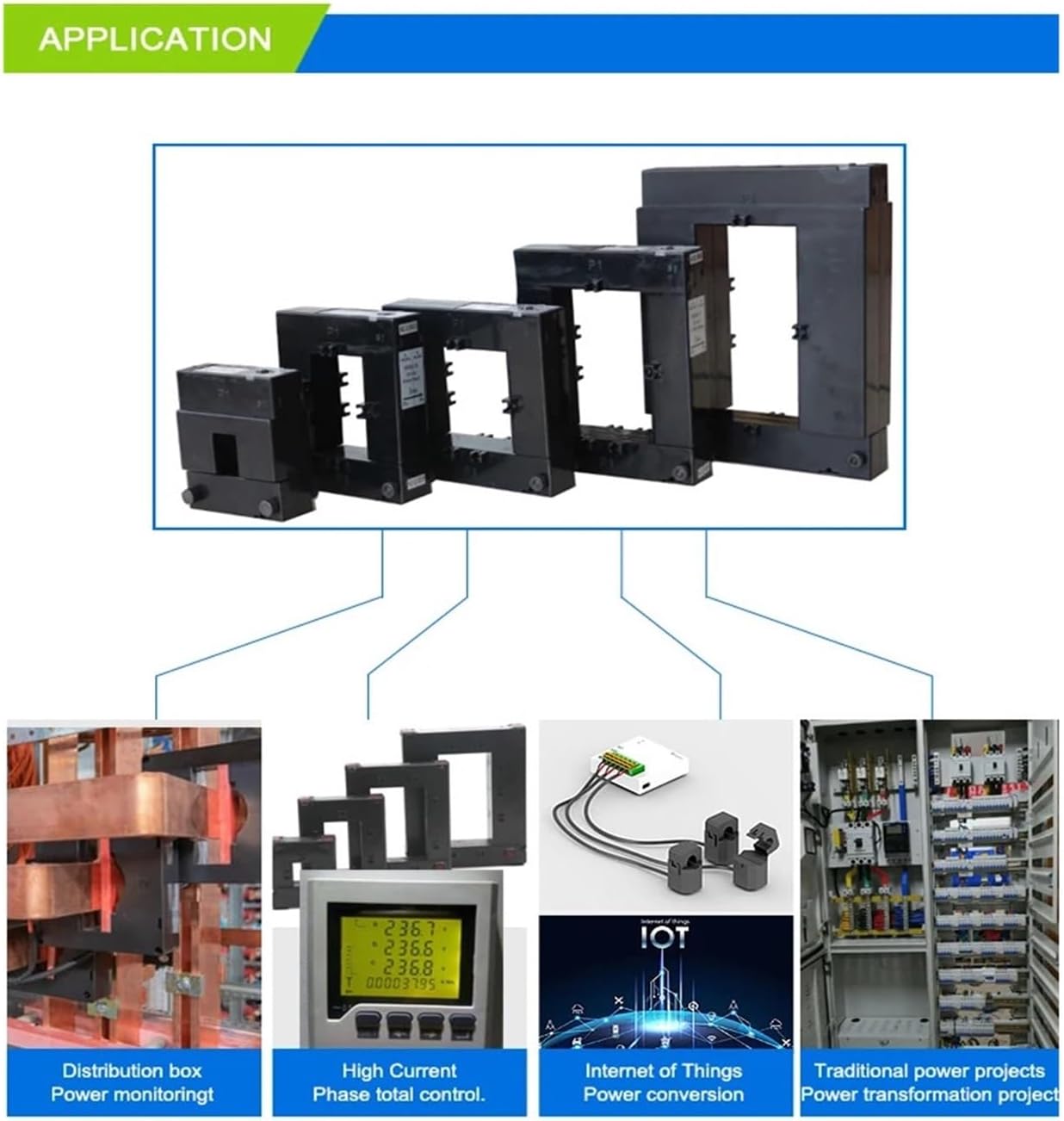
Proper installation ensures that the selected coherent tomography scanner will produce usable measurement results.
Before you begin, please check the following points:
When the primary current is flowing, the secondary winding of the current transformer, which produces the output current, must not be interrupted under any circumstances. The installation must include short-circuit protection devices and appropriate maintenance procedures.
A suitable split-type current transformer must meet both electrical requirements and available installation space.
To update the surveillance system in Singapore or other Southeast Asian countries, please submit the following information to HEYI:
Based on this data, HEYI can examine applications and recommend DP configurations for evaluation.
Are you planning to upgrade your energy monitoring system? Contact HEYI; we will help you choose bipolar current transformers, prepare the schematics and provide you with a quote for your project.
Compay:HEYI Electrical Co., Ltd.
Brand: HEYI/ASCT
Contact: Bethy
E-mail: heyi@heyiele.com
Tel: 86-13968747975
--- END ---
Already the last article

COPYRIGHT © HEYI ELECTRICS SOLUTION


