News | company news | May 14,2026
In modern low-voltage power distribution systems, protective current transformers play a crucial role in ensuring electrical safety, relay accuracy, and reliable fault detection.
For electrical equipment manufacturers, control panel builders, and industrial automation engineers, selecting the right protective current transformer is critical to the stable operation of protective relays, motor control centers (MCCs), and distribution bus systems.
The HPT series of protective current transformers is designed for use in low-voltage protection systems that require accurate short-circuit current detection and reliable relay operation.
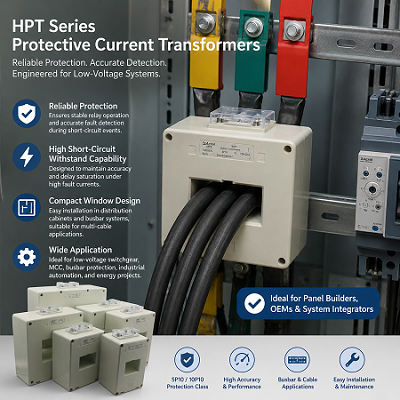
A protective current transformer (CT) is a type of current transformer used primarily for the following purposes:
relay protection
The Palace of the Circle revealed
Overcurrent monitoring
Incorrect insulation
Protection of electrical systems
Unlike standard current transformers, which ensure measurement accuracy under normal operating conditions, protective current transformers are designed to maintain accuracy even in the event of faults and high currents.
This is extremely important in the following aspects:
In modern switching systems, protective relays rely on stable and accurate current signals.
If the current transformer becomes saturated prematurely due to a fault, the relay may not function correctly:
This may lead to the following:

The HPT series has been optimized for switching and protection devices that require a compact design, stable operation, and ease of installation.
Typical applications of high-voltage current transformers
HPT series products are widely used in the following fields:
Suitable for motor control centers that require protection against overload and short circuits.
Tire protection system
The wide window design allows for flexible mounting options around copper busbars or multi-conductor busbars.
Industrial automation
It is used in factories, process control systems, and for monitoring industrial energy consumption.
Energy and infrastructure projects
Target audience:
Preventive computed tomography and dose computed tomography
Many engineers ask themselves the following question:
What is the difference between protective current transformers and standard current transformers?
The answer lies in its practical use.
| Jobs | Protection of computed tomography (CT) scans | Standard computed tomography |
| Main objective | relay protection | Energy measurement |
| Controlling short-circuit current | great | end |
| Saturation requirements | Delay saturation | Feeling full too early |
| precise focus | strong current | Normal operating conditions |
| A typical classroom | 5P10 / 10P10 | Difficulty level 0.5 / 1.0 |
HPT series protective current transformers are specifically designed to maintain reliable relay signals even under abnormal current conditions.

One of the most frequently asked questions by engineers online:
What does the code 5P10 on a power adapter mean?
The explanation is as follows:
5P = Protection accuracy level
10 = Height Limit Factor (ALF)
This means that the current transformer can maintain protection accuracy within a range of ten times the rated current without excessive errors.
Commonly used shielded computed tomography (CT) scanners include:
The appropriate classification depends on the following:
How to choose the right CT scanner
Choosing the right protective current transformer is crucial to ensuring the reliability of the relay.
Key selection criteria
1.Liquidity ratio
example:
100/5 A
200/5A
400/5 A
This ratio must be adjusted to match the system load and the input requirements of the relay.
2.Degree of accuracy
Common types of security systems include:
5P10
5P20
10P10
More stringent protection requirements typically require a higher Auto-Activation Factor (ALF).
3.Window dimensions
The following conditions must be met before operating the computed tomography (CT) scanner:
4.Load-bearing capacity
The total price includes the following:
Why do electrical appliance manufacturers prefer to use protective current transformers in window manufacturing?
Window-type protective current transformers are frequently used in low-voltage electrical distribution panels due to the following advantages:
The HPT series is particularly suitable for original equipment manufacturers (OEMs) and control cabinet manufacturers looking for reliable protection solutions.
Common problems that arise from choosing the wrong computed tomography (CT) scan method.
Using an inappropriate scanner could pose a serious security risk.
Frequently Asked Questions
CT scan saturation in the presence of defects
relay malfunction
imaginary trip
Inaccurate error detection
High temperature inside the control cabinet.
Choosing the right scanner security system can help improve the following:
High voltage protection transformer in modern power distribution systems
As modern electrical systems become more intelligent and smaller, protective current transformers must ensure the following:
Stable protective effect
small size
Flexible installation
Long-term reliability
The HPT series of protective current transformers is designed to meet the requirements of modern applications:
Electrical equipment manufacturers
Record production companies
Industrial Automation Systems Integrator
Energy infrastructure projects
In conclusion
Protective current transformers are essential components of modern low-voltage protection systems.
For manufacturers and engineers of electrical equipment, choosing the right protective current transformer has direct implications for the following aspects:
The HPT series of protective current transformers provides reliable solutions for protecting low-voltage relays, electrical switchgear, and industrial power distribution systems.
If you need a compact and reliable protective current transformer for use in electrical distribution boxes or busbars, the HPT series is ideal for modern electrical protection systems.
Compay:HEYI Electrical Co., Ltd.
Brand: HEYI/ASCT
Contact: Bethy
E-mail: heyi@heyiele.com
Tel: 86-13968747975
--- END ---

COPYRIGHT © HEYI ELECTRICS SOLUTION


