News | company news | Apr 06,2026
Looking for ANSI-compliant current transformers for your electricity metering needs? Discover how extended-range current transformers can improve the accuracy of electricity metering in 600V systems across the United States.
In America, engineers are no longer limited to standard current transformation ratios when selecting current transformers for electricity metering, commercial power distribution, and billing systems.
Their questions were more detailed and concerned technical aspects:
Can computed tomography maintain its accuracy under low and high workload conditions?
Is it suitable for ANSI/IEEE projects?
Can it be used for interior panels or exterior enclosures?
Is it compatible with inventory control devices for security purposes?
This is where wide range current transformers come in very handy.
Why is an extended measurement range essential in metrology applications?
In real electrical systems, current is not constant. Loads fluctuate over time. In many metering systems, especially for electricity billing, engineers must maintain stable accuracy not only at the nominal current but also across a wider range of operating parameters.
Standard current transformers only offer good performance within a narrow load curve range. On the other hand, extended-range current transformers are designed to maintain measurement efficiency over a wider current range, helping to improve measurement accuracy in dynamic systems.
This is especially important for electric utilities, switchgear manufacturers, and panel builders in North and South America when systems experience load fluctuations or partial loads.
When selecting current transformers for projects that comply with ANSI standards, engineers typically focus on the following five points:
1.Complies with ANSI/IEEE standards.
For many projects in North America and other US markets, IEEE C57.13 remains an important reference standard for current transformers. Selecting current transformers that comply with this standard simplifies technical analysis and equipment selection for a project.
2.Measurement accuracy
For metering and billing, accuracy is paramount. In applications requiring stable measurements, 0.3-meter class current transformers are often the preferred choice.
3.Extended accuracy range
In many applications, engineers prefer current transformers that maintain their performance under both extremely low currents and overload conditions. This is one of the most important reasons for choosing wide-range current transformers.
4.Installation conditions
Not all projects are carried out exclusively indoors. Some metering systems are installed in cabinets, kiosks, or distribution boxes, often in harsh environments. In these cases, engineers typically need a current transformer suitable for both indoor and outdoor installation.
5.Safety guarantee and metrological guarantees
In measuring systems, practical design details are crucial. For example, elements such as auxiliary short-circuit protection devices and sealed terminal covers contribute to ensuring safer operation and more reliable performance of the measuring systems.
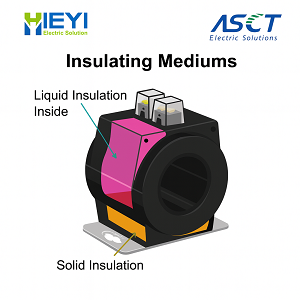
The RECT series of extended-range current transformers is designed for power systems up to 600 V and is suitable for metering and billing systems requiring high accuracy and installation flexibility. Specifications show that this series provides Class 0.3 measurement accuracy, supports current transformation ratios from 100/5 A to 800/5 A, is available in three window diameters (38 mm, 66 mm, and 78 mm), and complies with IEEE C57.13 standards. Furthermore, this series features short-circuit protection on the secondary side and sealed terminal covers, making it suitable for indoor or outdoor installation. The extended-range version maintains accuracy and current capacity within 1% to 150% of the rated current, a significant advantage for metering systems with varying load conditions.

This specification is attractive to engineers working in North and South America because it addresses both standards compliance and operational needs in the field:
Compliance with ANSI/IEEE standards simplifies project selection.
For electricity measurement at the account level, class 0.3 is used.
Modifying the parameter within a range of 1% to 150% can improve performance under different loads.
To ensure the integrity of the measurements, a sealed design is used.
To improve operational safety, an additional short-circuit protection device is installed.
A variety of window sizes and aspect ratios are available, allowing them to be adapted to a wider range of application scenarios.
This makes the product suitable for the following applications:
For indoor installations, the requirements relating to external protective housings must be met.
What are the advantages of an accuracy range of 1% to 150%?
This is one of the most important technological arguments in favor of the purchase.
Many engineers face a common problem: during off-peak hours, the actual load current can be significantly lower than the nominal value, while during peak hours it increases considerably. If current transformers do not ensure reliable meter operation within this range, it can affect billing accuracy.
Extended-range current transformers ensure accurate measurement across a wider current range, helping to mitigate these types of problems. This represents a significant technical and commercial advantage for projects with frequent load fluctuations.
Can it be used for outdoor work?
Yes, but a proper technical description is important.
Instead of stating that computed tomography is suitable for all situations of direct exposure to the external environment, it is better to use more precise and professional technical specifications:
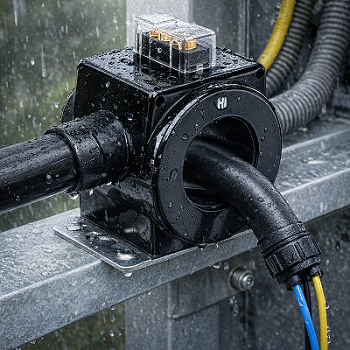
Suitable for indoor use or installation in outdoor enclosures.
This wording is particularly important for technology buyers in North and South America, as they typically need to distinguish between the following:
How to choose the right model?
When selecting a suitable current transformer, engineers must consider the following factors:
Required current coefficient
Window diameter
Loading requirements
Installation environment
Design standards (ANSI/IEEE)
Level of measurement accuracy
Load curve and extended range performance requirements
The RECT series offers a wide range of options, from 100/5A to 800/5A, with window diameters of 38 mm, 66 mm and 78 mm, making it easy to match the meters with different cable cross-sections and meter cabinet designs.
in conclusion
For engineers and original equipment manufacturers (OEMs) operating in America, selecting the right current transformer (CT) is not simply a matter of turns ratio, but also of standards compliance, billing accuracy, safety, and actual operating range.
If your project requires a 600V current transformer that meets ANSI standards, with a rated capacity of 0.3, a range of 1% to 150%, and is suitable for indoor or outdoor use, then an extended-range current transformer like the RECT series is a practical solution worth considering.
Compay:HEYI Electrical Co., Ltd.
Brand: HEYI/ASCT
Contact: Bethy
E-mail: heyi@heyiele.com
Tel: 86-13968747975
--- END ---

COPYRIGHT © HEYI ELECTRICS SOLUTION


