News | | Jan 12,2026
In modern low-voltage power distribution systems, power companies and distribution operators face three core requirements:
secure isolation, reliable protection, and accurate current measurement.
Strip-type fuse switch disconnectors are widely used in power company feeder cabinets, customer access cabinets, and low-voltage distribution boxes for load isolation and short-circuit protection. However, they cannot tell us
I need to know how much electricity is flowing on the line. I need to know if the line is overloaded. I need to know if the circuit is unbalanced.
This is precisely the significance of the SFCT series current transformer.
The current sensor is a sensor. I install the sensor inside strip-type fusible disconnect switches.
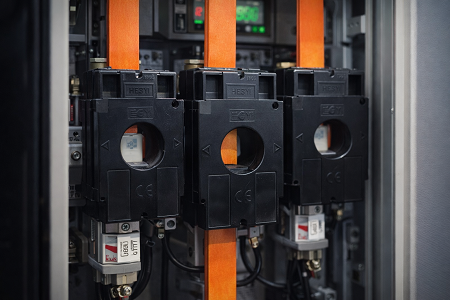
I have seen that traditional current transformers are large. The large traditional current transformers need mounting brackets and extra wiring space. Strip-type fuse disconnect switches have internal space.
When I look at the SFCT I see a window type, structure. You can install the SFCT directly on the busbar. You can also install the SFCT on the cable, inside the disconnector switch. You do not need to change the switch structure, for the SFCT.
This means:
No additional CT mounting box required
No extra cabinet space is needed.
In my experience the switch body structure does not change.
I think SFCT belongs to the “system. SFCT is not an add‑on.
The core task of a strip-type fuse disconnector is
to safely open and close the circuit under load and fault conditions.
This will produce:
I notice that the ordinary CT scanners tend to have distortion in those environments. The SFCT is built for this use. The SFCT keeps output when switching operations happen and load changes.
This is critical to the system because:
The protection relay depends on the signal. The protection relay decides if the protection relay should trip.
I know that the electricity meters rely on it for measurement. The electricity meters need it to measure accurately.
In my work I see that automation systems rely on a connection, for control. Automation systems use the connection to run machines from away.
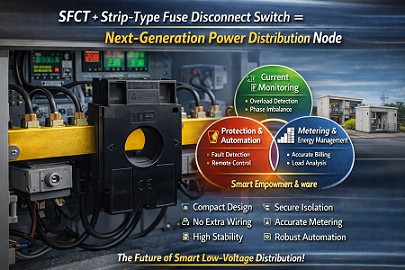
When I add SFCT to the strip‑type disconnector the switchgear that was purely mechanical instantly gets three capabilities:
① Feeder current monitoring
Real-time detection is possible.
Overload
Three-phase imbalance
Abnormal electricity usage
② Protection and Automation
SFCT gives a signal for:
Overcurrent protection
Fault detection
Remote tripping and reclosing
To enable ordinary power distribution cabinets to have “smart grid” capabilities.
③ Metering and Energy Management
SFCT gives the 0.5 grade accuracy or the 1 grade accuracy. SFCT helps with:
Billing
Load Analysis
Energy Management
This means that a single switch can simultaneously perform:
protection, metering, and data acquisition.
Power companies are upgrading to smart low‑voltage switchgear. Power companies see uses, for the switchgear, such, as:
Roadside feeder cabinet
Residential and commercial user access cabinets
Small low-voltage substation
Distribution automation terminal
They require:
High security
Fewer wires
Low maintenance
Multiple data
We install the SFCT directly inside the fuse disconnect switch. The SFCT avoids the problems that come with CTs.
Incorrect wiring
Insufficient space
High installation costs
Increased number of potential failure points
I think the power company likes this structured solution. The power company finds the structured solution useful.
When you combine a strip-type disconnector, with an SFCT, the strip-type fusible disconnector and the SFCT no longer act as a switch. The strip-type fusible disconnector and the SFCT become a:
I use a low-voltage power distribution node in my projects. The low-voltage power distribution node is a device. The low-voltage power distribution node combines protection, measurement, monitoring and automation.
This is precisely the future direction of power distribution network development:
SFCT is not “barely usable here”,but a current transformer specifically designed for this application.
Compay:HEYI Electrical Co., Ltd.
Brand: HEYI/ASCT
Contact: Bethy
E-mail: heyi@heyiele.com
Tel: 86-13968747975
--- END ---

COPYRIGHT © HEYI ELECTRICS SOLUTION


