SUM155 Summation Current Transformer

Summation current transformers (SUM series) combine multiple synchronous AC currents with similar phase positions but different load phase shifts or nominal voltages. They are not suitable for tariff measurements due to voltage differences.
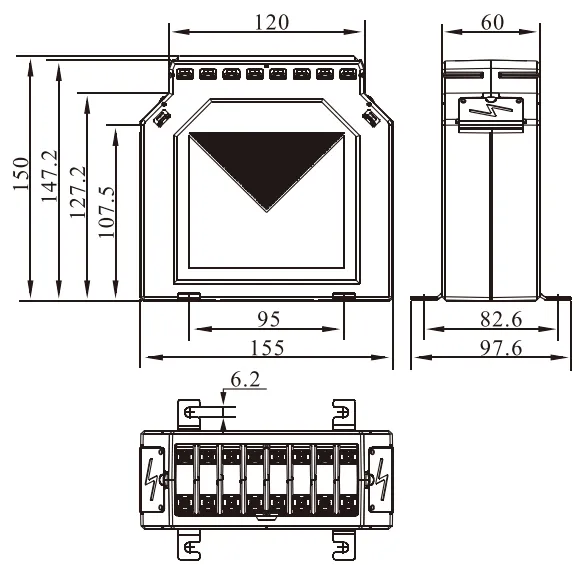
SUM125 can be mounted horizontally using four M6 screws or on a 35 mm DIN rail; SUM155 requires four M6 screws.

Introduce

Summation current transformer are suitable for the summation of several synchronous alternating currents with similar phase position.but with different loaded phase shifts. lt is also possible to have the summation of currents with varied nominal voltages of similar phase positions These measurements are not suitable for tariff applications, since the existing voltage differences are recorded as errors.

Applications

  • Summary of Current Signals in Power Systems
  • Multi channel current monitoring in industrial automation
  • In situations where multiple current signals need to be merged into one signal
  • Power system protection and control devices

Sdandard
The application of SUM125 Summation Current Transformer in the power system must meet the following standard requirements:

1. Power system protection standards: such as IEEE C57.12.90-2021 testing requirements for power transformers.
2. EMC standards: including electromagnetic compatibility requirements such as EN 55022 (conducted interference) and EN 55015 (space radiation).
3. Safety standards: requirements for enhanced insulation, such as IEC 61558-1 and UL 62368-1.

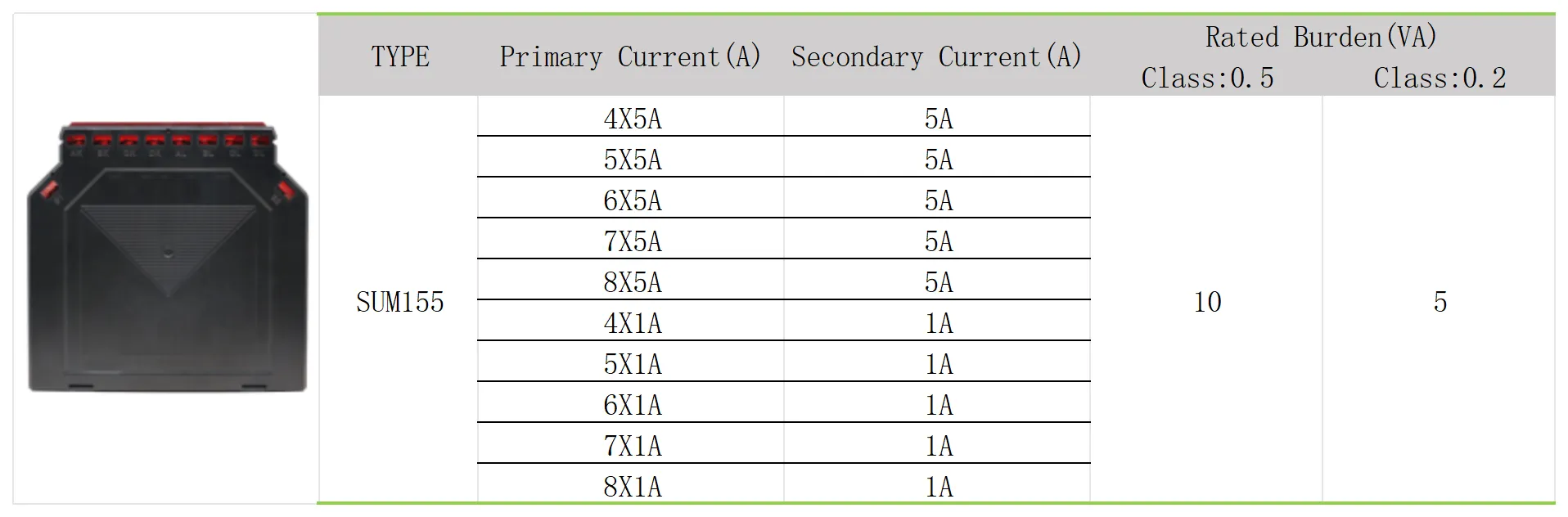
Technical Parameter

Summation Current Transformer parameter

Dimensions

Summation Current Transformer Dimensions

FAQ

1. How many CT secondary currents can the SUM155 combine?

The SUM155 combines multiple AC current signals into one output. The required number of inputs should be specified when requesting a quotation so we can confirm the suitable configuration.

2. Can CTs with different ratios be connected to one summation current transformer?

The input CT ratios and secondary currents must be checked as part of the overall measurement design. Please provide each CT ratio, its 1 A or 5 A secondary rating, and the required output ratio so we can verify the configuration.

3. How do I select the rated burden for a summation current transformer?

Calculate the burden of the connected meter or controller and the secondary cables, then compare the total with the summation CT’s rated burden. For selection, please provide the cable length, conductor size, connected device and required accuracy class.

4. How should the input CTs be wired to the SUM155?

Connect each CT secondary to its assigned input terminals according to the approved wiring diagram, keeping the CT polarity consistent. Confirm the terminal arrangement for the selected configuration before installation. Never leave an energized CT secondary open-circuited.

5. Can the SUM155 be used for revenue or tariff metering?

The product page does not recommend this summation CT for tariff measurement where differences in nominal voltage can introduce measurement errors. If the project involves billing, please share the metering scheme and applicable requirements for a separate review.

Inquiry Now

    JOIN US

    Register as one of our members and provide you with the latest product and discount information.