News | company news | Jun 28,2025
An extended range current transformer is a specially designed current transformer whose main feature is its ability to maintain a specified measurement accuracy or protection accuracy over a wider current range than a standard current transformer, especially under overload or short-circuit current conditions well above its rated current.
Detailed explanation of the key features and principles of HEYI’s RECT :
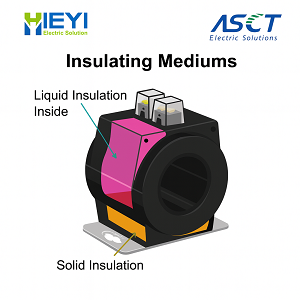
1.Core purpose: Solve the saturation problem
The core material (usually silicon steel sheet) of an ordinary current transformer (CT) will enter a magnetic saturation state when the current exceeds a certain multiple of its rated value.
Once saturated, the secondary output current of the CT can no longer truly reflect the changes in the primary current (the waveform will be distorted and the amplitude will be limited), resulting in serious measurement inaccuracy or failure of the protection relay to operate correctly.
The core goal of the extended range CT is to significantly improve the anti-saturation capability so that it can still maintain sufficient accuracy under very large fault currents (e.g., tens of times the rated current).
2.Key implementation technologies:
High-performance core material:
This is the main means to achieve extended range. Usually used:
Iron-based amorphous alloy:
It has extremely high saturation flux density and very low coercivity, high magnetic permeability and low loss. This allows it to withstand larger currents without saturation at the same size.
Microcrystalline (nanocrystalline) alloy: also has high saturation flux density and excellent magnetic properties.
Optimizing core design:
Sometimes a larger core cross-sectional area or special magnetic circuit design is used in combination to further improve the resistance to saturation.
Special winding design:
In protective Extended Range Current Transformer, special winding methods (such as compensating windings) are sometimes used to improve performance at high currents.
3.Main advantages:
Wide dynamic range:
Able to provide accurate output in the range from very small (near zero) to very large (e.g. 20 times, 30 times or even higher rated current).
Excellent anti-saturation performance:
When a serious short-circuit fault occurs in the power system, even if the primary current is extremely large, the secondary output current can maintain a linear proportional relationship with the primary current, with no waveform distortion and no amplitude clipping.
High-precision protection:
This is a crucial feature for protection relays (such as differential protection, distance protection, and overcurrent protection). It ensures that under the maximum possible fault current, the relay can accurately and reliably detect the fault and quickly trip to protect the safety of power equipment and systems.
Stable measurement accuracy:
For measuring CTs (usually with higher accuracy requirements), the extended range design can also ensure that the nominal accuracy level can be maintained over the entire expected operating current range when the load fluctuates greatly (for example, the “S” in 0.3 and 0.5 levels means better performance over a wide range).

4.Application scenarios:
Key nodes for power system protection: such as generator outlets, high/low voltage sides of large transformers, busbar protection, important feeder outlets, etc., where short-circuit current levels are usually very high.
Applications where high-precision and wide-range measurements are required: such as electric energy metering (especially for users with large load fluctuations), power monitoring, power quality analysis, etc.
Modern digital substation (IEC 61850): higher requirements are placed on the transient characteristics of CTs, and extended range CTs can better meet the requirements.
5.Comparison between HEYI’s RECT and standard CT:
Standard CT: Usually the accuracy is highest near the rated current. As the current increases (especially after exceeding its “accuracy limit factor” ALF), the accuracy drops rapidly and the risk of saturation is high. For example, a 5P20 ordinary protection CT has an error of no more than 5% at 20 times the rated current, but it may saturate when it exceeds this multiple.
Extended range CT: Even if the current is much higher than its nominal ALF (e.g. 5P30, 5P40), it can keep the error within the specified limit (e.g. 5%) and is not easy to saturate. For example, CT using amorphous alloys can reach 5P50 or even higher. Its magnetization curve is more linear and the saturation point is higher.
6.Cost considerations:
High-performance core materials (such as amorphous alloys) cost significantly more than traditional silicon steel sheets.
Therefore, the price of Extended Range Current Transformer is usually higher than that of ordinary CT of the same transformation ratio and accuracy.
Its application requires a balance between cost and system safety requirements, and is usually used in situations where extremely high protection reliability is required or a wide measurement range is required.
Compay: WENZHOU HEYI ELECTRICAL CO.,LTD
Brand: HEYI/ASCT
Contact: Bethy
E-mail: heyi@heyiele.com
Tel: 86-13968747975
--- END ---

COPYRIGHT © HEYI ELECTRICS SOLUTION


