News | company news | Apr 10,2025
Operation and maintenance of current transformers
Overload operation of current transformer
The current transformer can work for a long time at 1.1 times the rated current, but long-term overload operation will affect the measurement accuracy. Due to the increase in magnetic flux density and the saturation of the core, the core will heat up, accelerate the aging of the insulating medium, shorten its life, and even cause damage. Therefore, if the current transformer is found to be frequently overloaded during operation, it should be replaced in time.
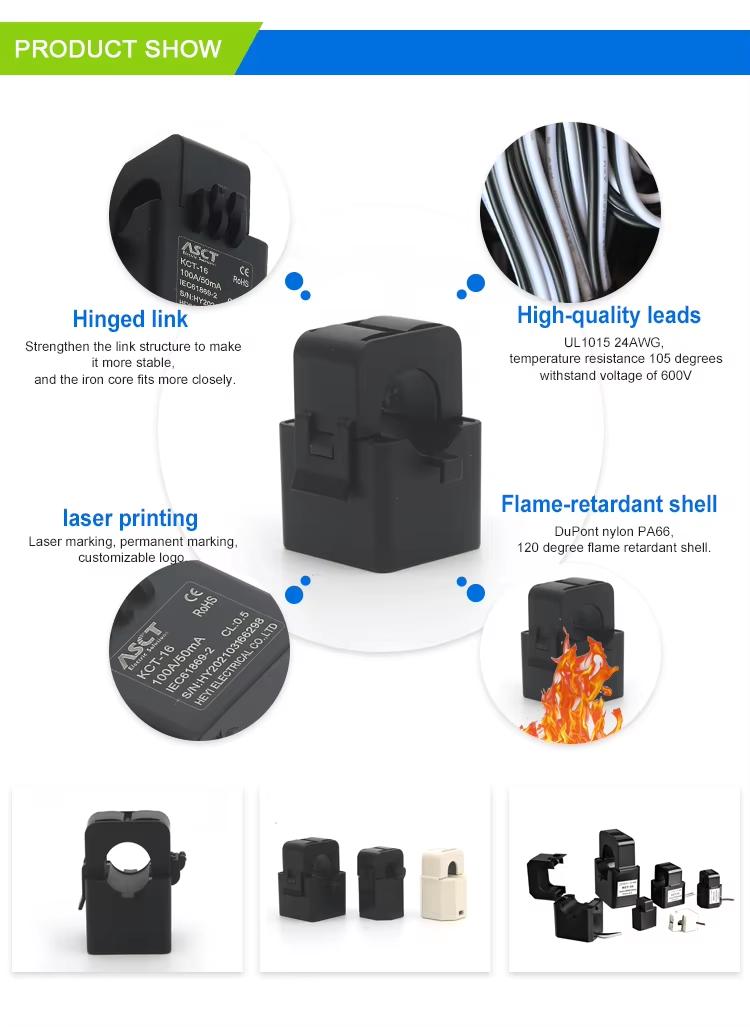
Serious consequences and treatment of open circuit of current transformer secondary circuit
When the current on the primary side of the current transformer remains unchanged and the secondary circuit is open for some reason, that is, the secondary current is equal to zero, the demagnetizing effect of the secondary current disappears, and the primary current is completely converted into excitation current, making the core magnetic flux saturated, which will have the following consequences:
1.Due to the saturation of magnetic flux, the waveform of the magnetic flux becomes a flat-top wave, and the secondary induced potential appears as a peak wave, which will generate a voltage of several kV or even higher, posing a threat to the secondary insulation and causing danger to personnel;
2.Increase the core loss, generate severe heat, and burn out the coil insulation;
3.Residual magnetism will be generated in the iron core, which will increase the current difference and angle difference of the current transformer and affect the accuracy of measurement.
Therefore, it is strictly forbidden to open the secondary circuit of the current transformer during operation. If it is necessary to disconnect the instrument or relay protection circuit, the terminal block needs to be short-circuited. If the secondary circuit of the current transformer is found to be open during operation, the operator should immediately reduce the load current on the primary side or reduce it to zero, disable the relay protection device, and handle it with insulating tools.
Precautions when working on the secondary circuit of the current transformer in operation
When working on the secondary circuit of a current transformer in operation, you must fill out the work ticket in accordance with the requirements of the “Electric Power Safety Work Regulations” and pay attention to the following items:
1.It is strictly forbidden to open the secondary circuit of the current transformer during work;
2.Short-circuit the secondary circuit of the current transformer at an appropriate location as needed. Short-circuit should be done with a short-circuit plate or a special short-circuit line. The short-circuit should be done properly and reliably. It is forbidden to use fuses or general wire windings.
3.It is forbidden to perform any work on the circuit between the current transformer and the short-circuit point;
4.When working, there must be someone to supervise, use insulating tools, and stand on insulating mats;
5.When cleaning the secondary line, the on-duty personnel should use dry cleaning tools, wear long-sleeved work clothes, wear wire gloves, and take off metal objects such as watches when working. Be serious and cautious during work to avoid damaging components or causing secondary circuit disconnection, and do not disconnect the permanent grounding point of the circuit.
Replacement of current transformer and secondary line
When a current transformer and its secondary line in operation need to be replaced, in addition to complying with the relevant safety work regulations, the relevant regulations must also be followed.
1.When replacing a damaged current transformer, a current transformer of the same model and specification should be selected, with correct polarity, similar volt-ampere characteristics, and qualified by test;
2.When replacing current transformers in groups, in addition to paying attention to the above requirements, the relay protection setting value and the meter measurement multiplier should be reviewed again;
3.When replacing the secondary cable, the cable cross-section, number of cores, etc. must meet the requirements of the maximum load current, and the insulation resistance of the new cable must be measured. After replacement, the wiring must be checked for correctness;
4.For newly replaced current transformers or changed secondary wiring, the polarity of the entire secondary circuit must be measured before operation.
Inspection of current transformer
Before the current transformer is put into operation, in addition to the acceptance test items in the relevant test procedures and the acceptance test items must be tested and qualified, the following inspections should also be carried out:
1.The oil-filled current transformer should have a clean appearance, sufficient oil, and no oil leakage.
2.There are no cracks or damage on the porcelain bushing and other insulating materials.
3.The screws of the primary side leads, wire clips and secondary circuit connections should be tightened and the contact should be good.
4.The casing and the secondary circuit are well grounded at one point (but the secondary circuit of the low-voltage current transformer used for electricity metering and billing must not be grounded).
5.Maintenance of current transformer in operation
6.The current transformers put into operation are generally subject to preventive tests every 1 to 2 years, and the above inspections are performed.
7.The secondary circuit of the current transformer is not allowed to be open. Care should be taken to prevent the secondary circuit wire from being broken during operation.
8.Carefully check whether the secondary circuit wires are loose. The cross-sectional area of the current circuit wire of the metering unit should not be less than 4mm2 copper wire, and the cross-sectional area of the control, signal and other wires of the auxiliary unit should not be less than 1.5mm2 copper wire; the three-phase indication value of the ammeter is within the allowable range.
9.The sound inside the current transformer is normal, without crackling discharge or other noise or burning smell.
--- END ---

COPYRIGHT © HEYI ELECTRICS SOLUTION


