How to properly connect a three-phase current transformer?
1. Safety Precautions
- De-energize the Circuit: Before working on the electrical system, make sure to disconnect the power supply to avoid electric shock.
- Use Personal Protective Equipment (PPE): Wear insulated gloves, safety goggles, and other appropriate PPE.
- Follow Lockout/Tagout Procedures: Ensure the system is properly locked out and tagged out to prevent accidental energization.
2. Understand the CT Configuration
three-phase current transformer can be configured in various ways depending on the system:
- Wye (Star) Connection: Common for balanced loads.
- Delta Connection: Often used in certain industrial settings.
- Open Delta (V) Connection: Used for cost savings where only two CTs are needed for three-phase measurement.
3. Identify the Terminals
- Primary Side: This side connects to the high-voltage line. It usually has a label such as P1 and P2.
- Secondary Side: This side is connected to the measuring instrument or protection relay, labeled S1 and S2.
4. Installation Steps
A. Prepare the CT
- Inspect the CT: Check for any physical damage.
- Check Ratings: Ensure the CT rating matches the system voltage and current levels.
- Orientation: Ensure the CT is oriented correctly with P1 facing the incoming power side and P2 facing the load side.
B. Connect the Primary Side
- Identify Phase Lines: Determine which lines are the A, B, and C phases.
- Connect Each Phase:
- Phase A: Connect the primary winding of CT1 (P1 to P2) around the Phase A conductor.
- Phase B: Connect the primary winding of CT2 (P1 to P2) around the Phase B conductor.
- Phase C: Connect the primary winding of CT3 (P1 to P2) around the Phase C conductor.
- How to properly connect a three-phase current transformer?
C. Connect the Secondary Side
- Connect to Measuring Devices:
- Wye Configuration:
- Connect S1 of CT1, CT2, and CT3 to the corresponding terminals on the measuring device.
- Connect S2 of all three CTs together and then to the neutral of the measuring device.
- Delta Configuration:
- Connect S1 of CT1 to S2 of CT2, S1 of CT2 to S2 of CT3, and S1 of CT3 to S2 of CT1.
- Connect these points to the measuring device.
- Open Delta Configuration:
- Connect S1 of CT1 to the measuring device and S2 of CT2 to the measuring device.
- S2 of CT1 and S1 of CT2 are connected together and ground.
- Grounding:
- Wye Configuration: Connect the common point of S2 terminals to ground.
- Delta Configuration: Typically, one of the S2 terminals is connect to ground.
5. Test the Connection
- Insulation Resistance Test: Ensure the insulation resistance is adequate between the CT windings and ground.
- Polarity Check: Verify the polarity to ensure correct phase orientation.
- Function Test: Energize the system and check the measurements.
6. Monitoring and Maintenance
- Regular Inspection: Periodically check the connections for tightness and signs of wear or damage.
- Calibration: Schedule regular calibration to maintain accuracy.
Diagram Example
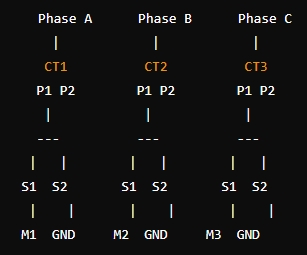
Wye (Star) Connection Example:

This diagram shows each CT connected to its corresponding phase, with the secondary sides S2 tied to ground.
Delta Connection Example:

In the Delta configuration, S1 of one CT connects to S2 of another, forming a closed loop with each CT contributing to the measurement.
Following these guidelines will help ensure a correct and safe connection for three-phase current transformers.
--- END ---